A Self-Sustainable, Ultrarobust and High-Power-Density Triboelectric Nanogenerator for In-Situ Powering of Marine Internet of Things
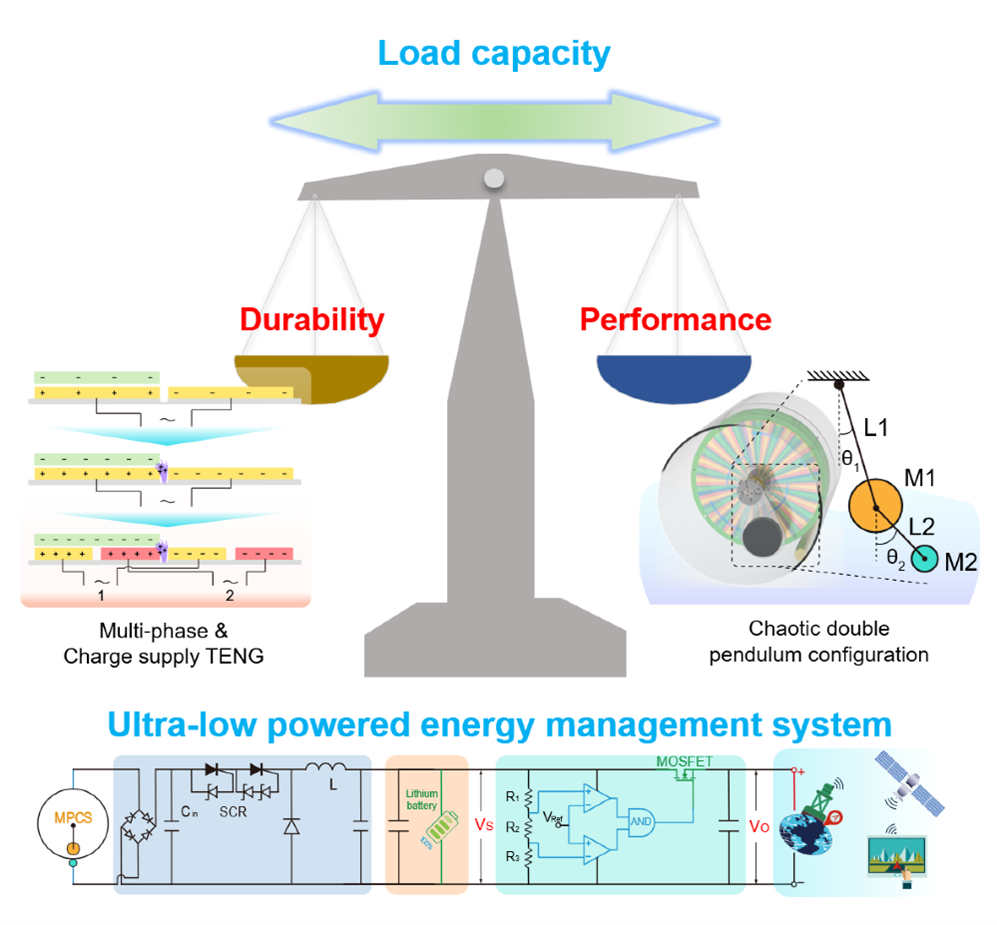
The sustainable operation of marine Internet of Things (IoT), as a critical enabler for marine resource utilization, is hindered by the lack of robust energy solutions capable of powering advanced functionalities in unpredictable oceanic environments. Here, we present a self-sustainable, highly reliable triboelectric nanogenerator system that synergizes a non-contact architecture with dynamic charge supplementation and multiphase electrode design to overcome persistent limitations in durability, energy storage, and water wave adaptability. The system achieves a 3-fold enhancement in output charge with 97% performance retention over 20 million cycles—5.2 times more durable than state-of-the art counterparts. A chaotic double-pendulum structure further broadens operational bandwidth to 0.4–1.0 Hz with the charge accumulation rate of 4.6 times, enabling record-breaking average power density of 13.53 W m⁻³ Hz⁻¹. Furthermore, an adaptive ultralow-powered (244 nW) integrated management circuit with on-demand direct current supply functionality ensures a 394-fold energy storage speed, successfully sustaining real-time GPS communication and water quality monitoring in autonomous buoys. This work establishes a scalable, maintenance-free paradigm for marine energy harvesting, directly addressing the energy paradox in IoT deployment while advancing sustainable resource management and climate resilience strategies.